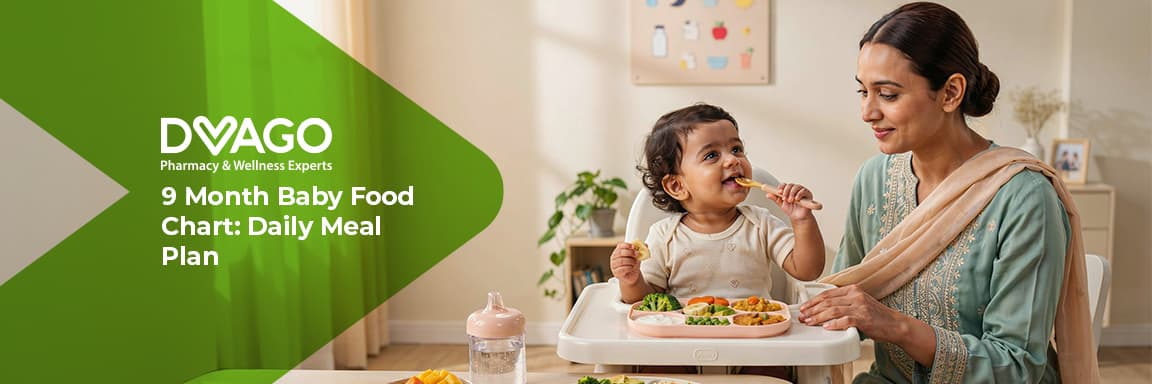
9 Month Baby Food Chart: Daily Meal Plan
If you are looking for a 9-month baby food chart with a daily meal plan, your baby has reached a real turning point in feeding. Around 9 months, meals step up to a more grown-up pattern — about three meals a day plus one or two small snacks — with chopped and lumpier textures, harder finger foods, and confident self-feeding, all while breast milk or formula continues alongside.
This is the age when solids start to take up a bigger share of the day. The World Health Organization (WHO) recommends that from 9 months, breastfed babies have complementary foods 3 to 4 times a day, with 1 to 2 nutritious snacks. UNICEF, the NHS, the American Academy of Pediatrics (AAP) and the CDC all support offering a wide variety of family-style foods at this stage.
This guide gives you a food chart, a full daily meal plan, portions, textures, finger foods, allergens, hydration and safety. Everything is based on trusted medical guidelines. The chart and portions are examples to guide you, not strict rules — let your baby's appetite lead, and check with your paediatrician about anything specific to your child.
Quick Answer
In short:
Offer about 3 meals a day plus 1 to 2 small snacks, alongside continued breast milk or formula.
Move to chopped and lumpier textures and harder finger foods — your baby can now manage more than one texture in a meal.
Keep iron-rich foods a daily focus: daal, minced chicken or meat, well-cooked egg, and iron-fortified cereal.
Encourage self-feeding. Around 9 months the pincer grasp (finger and thumb) lets babies pick up small pieces.
Offer all drinks other than breastfeeds from an open cup or beaker. Milk is still an important part of nutrition.
9 Month Baby Food Chart (Foods & Textures)
This chart shows food groups suitable at 9 months, with example foods, portions and textures. Offer a wide variety across the day, and keep including an iron-rich food daily. Portions grow with your baby's appetite.
Portions are examples based on published guidance, not targets your baby must reach. Trust your baby to eat as much or as little as they want, and never force-feed.
Daily 9 Month Meal Plan (Example Day)
By 9 months, a typical day includes three solid meals and one or two small snacks, with milk feeds around them. WHO guidance for this age is 3 to 4 complementary meals per day plus 1 to 2 snacks. The plan below is one example — adjust to your baby's routine and appetite.
This is one example of a day, not a fixed schedule. The number of meals, snacks, timing and amounts vary with each baby. Some days they eat more, some days less — that is normal.
Textures and Self-Feeding at 9 Months
Nine months is a confident stage for self-feeding. The pincer grasp — picking up small pieces of food between finger and thumb — typically develops around 8 to 9 months, so you can offer both larger sticks your baby holds in the palm and small soft pieces to practise the pincer. Babies do not need teeth to eat; their gums manage soft foods well.
Textures move on to chopped and lumpier foods and harder finger foods. Many babies can now handle more than one texture in a single meal — for example, soft rice with chopped vegetables. Offering this variety of textures helps develop the chewing and mouth movements needed for family foods and for speech. Most homemade family foods are suitable now, as long as they are cooked without added salt, sugar or heavy spices.
Safe Finger Foods
Good finger foods are soft enough to squash between your fingers and cut into shapes your baby can hold. Examples include soft-cooked vegetable sticks (carrot, potato, sweet potato, lauki), soft fruit (banana, ripe mango, melon, soft pear), small pieces of soft roti or bread, and soft pieces of well-cooked chicken, meat or egg. Always cook soft, cool the food, and cut to a safe size.
Safety basics:
Always seat your baby upright and never leave them alone while eating. Avoid whole nuts, whole grapes, popcorn and other hard, round, sticky or crumbly foods. Gagging is a normal, noisy reflex that usually resolves in seconds; choking is silent and needs immediate action.
How Much Should a 9-Month-Old Eat?
Appetite varies a lot, so there is no single correct amount. A common guide at this age is around 4 to 6 tablespoons per meal across three meals, plus one or two small snacks — but let your baby decide how much to eat rather than aiming for an exact figure. Portions grow naturally as your baby becomes a more skilled eater.
Milk remains an important source of nutrition at 9 months, though solids now provide more energy than before. Keep offering regular breast or formula feeds. As your baby eats more solids, milk feeds continue to reduce gradually — there is no need to cut them back sharply.
Let your baby lead:
Fullness cues include turning the head away, closing the mouth, pushing food away, or playing with food. Stop there. Responsive feeding, where your baby sets the pace and amount, supports healthy appetite regulation.
Foods to Avoid at 9 Months
• Honey — risk of infant botulism under 12 months of age.
• Cow's milk, buffalo milk or goat's milk as a main drink before 12 months (small amounts in cooking or yogurt are fine).
• Added salt and sugar. Set aside a portion of family food before salt and spices are added.
• Whole nuts, whole grapes, popcorn, hard raw vegetables, and other hard, round or sticky choking hazards.
• Sugary drinks, fruit juices, tea and fizzy drinks.
• Very spicy, oily or heavily salted family dishes. Keep your baby's portion plain.
Allergens at 9 Months
If you have already introduced common allergens such as egg, peanut (as smooth, thinned peanut butter), dairy, wheat, fish and sesame, keep offering them regularly — about twice a week — to help maintain tolerance. If any allergens are still not introduced, you can do so now: one at a time, in a small amount, earlier in the day, when your baby is well.
Signs of an allergic reaction can include a new rash or hives, swelling of the lips or face, vomiting, or difficulty breathing. Severe reactions are a medical emergency — seek help immediately. If your baby has severe eczema or a known food allergy, speak to your doctor before introducing peanut or egg.
Hydration
At 9 months, offer all drinks other than breastfeeds from an open cup or free-flow beaker rather than a bottle, to support cup-drinking skills and protect your baby's teeth. Small amounts of safe water with meals are ideal. Breast milk or formula still provides most of your baby's fluid.
In Pakistan, use safe drinking water; tap water for babies under 12 months should generally be boiled and cooled first unless you are sure it is safe. If your baby is unwell with diarrhoea or vomiting, contact a doctor, who may advise oral rehydration solution.
Breastfeeding and Formula at 9 Months
Keep breastfeeding or formula feeding alongside solids. WHO and UNICEF recommend continued breastfeeding to 2 years or beyond, together with a varied diet. As solids increase, breastfed babies often naturally drop to fewer milk feeds a day, usually morning and evening, over the following months.
If your baby is formula fed, continue an iron-fortified infant formula; a common guide at this stage is around 400 ml (about 14 oz) a day, adjusted to your baby's needs. Do not switch to cow's or buffalo milk as a main drink before 12 months, as this raises the risk of iron deficiency anaemia.
Common Mistakes Parents Make
• Staying on smooth or mashed foods only. By 9 months, offer chopped, lumpier foods and harder finger foods.
• Skipping finger foods for fear of choking. With soft foods and close supervision, self-feeding is safe and important for development.
• Relying only on rice or roti. Variety and daily iron-rich foods matter at every meal.
• Adding salt, sugar or lots of spice. Keep the baby's portion plain.
• Giving all drinks from a bottle. Move to a cup or beaker for water and other drinks.
• Letting snacks or juice spoil main meals. Keep snacks small, nutritious and spaced out.
• Forcing the baby to finish. Let appetite and fullness cues lead.
Frequently Asked Questions
How many meals should a 9-month-old eat?
About 3 meals a day plus 1 to 2 small snacks, alongside continued breast milk or formula. This matches WHO guidance, which recommends 3 to 4 complementary meals plus 1 to 2 snacks for babies aged 9 to 23 months.
How much should a 9-month-old eat per meal?
A common guide is around 4 to 6 tablespoons per meal, but appetite varies. Offer food across food groups and let your baby decide how much to eat. Milk is still important, so keep milk feeds going.
What finger foods can I give a 9-month-old?
Soft foods your baby can squash and hold, such as soft-cooked vegetable sticks (carrot, potato, lauki), soft fruit (banana, mango, melon), small pieces of soft roti or bread, and soft well-cooked chicken, meat or egg. Cook soft, cool, cut to a safe size, and supervise closely.
What textures are right at 9 months?
Chopped and lumpier foods and harder finger foods. Many babies can now manage more than one texture in a meal. Most homemade family foods are suitable if cooked without added salt, sugar or heavy spices.
What should a 9-month-old drink?
Breast milk or infant formula remains the main drink, with small amounts of safe water in a cup at meals. Offer all drinks other than breastfeeds from a cup or beaker rather than a bottle. Cow's or buffalo milk should not be a main drink before 12 months.
Can a 9-month-old eat family food?
Yes, most homemade family foods are suitable at this age, as long as you set aside your baby's portion before adding salt, sugar or heavy spices, and prepare it in a safe texture and size.
Should I stop breastfeeding at 9 months?
No. WHO and UNICEF recommend continuing breastfeeding to 2 years or beyond alongside solids. Milk feeds naturally reduce over time as solids increase, but they remain valuable.
Conclusion
A helpful 9 month baby food chart reflects a real shift: about three meals a day plus small snacks, chopped and lumpier textures, harder finger foods and confident self-feeding, with breast milk or formula still an important part of nutrition. Everyday foods from your own kitchen — daal, khichdi, chopped soft-cooked vegetables, fruit, well-cooked egg, minced chicken and plain yogurt — cover most of what your baby needs, with iron-rich foods offered daily and plenty of variety.
Aim for three meals with one or two snacks, progress textures at your baby's pace, keep offering allergens you have introduced, move drinks to a cup, and let your baby's appetite guide how much they eat. Always supervise meals and keep foods soft and safe. If you have any concerns about feeding or growth, your paediatrician or Lady Health Worker can give advice tailored to your child.
Medical Disclaimer
This article is for general information and education only. It is not a substitute for professional medical advice, diagnosis or treatment. Feeding needs differ from baby to baby, and babies born prematurely, with low birth weight, allergies, reflux or other medical conditions may need different guidance. Always consult a qualified paediatrician or registered health professional about your own child's feeding, growth or health. If your baby is unwell or you suspect an allergic reaction, seek medical care promptly.